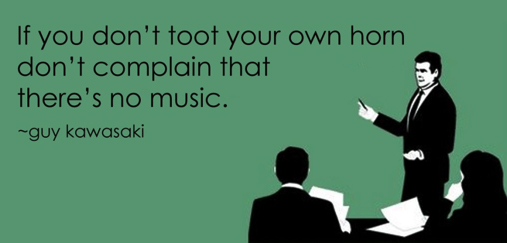
Have you ever relished the opportunity to cast yourself in the limelight, speak at great lengths about your qualities, or go on and on about your numerous achievements? Me either! If you’re like many, you tend to be reserved about tooting your own horn and hesitant to discuss work-related achievements. However, in an emerging professional environment characterized by specialization and growing complexity, many employees find themselves working independently and managing many work-related decisions - making them the expert historian on their performance. This is where an employee’s self-assessment becomes an essential tool in the performance management process. Think of it as a highly encouraged practice of professional horn tooting!
So what is a self-assessment and when is it appropriate? Whether you are a Bargaining Unit Employee (BUE) covered under the Pass/Fail program or a Non-BUE falling under Valuing Performance (VP), the self-assessment serves the same purpose: to document accomplishments against the standards of an employee’s performance plan. While the format can vary between the two programs, understanding how to construct the content is key. When creating a self-assessment, employees shouldn’t simply list the tasks they’re responsible for. More importantly they should take the time to document not only what’s been done, but how well it’s been done. What was the impact on the team, the organization, or the agency? What metrics were achieved and did they exceed the standards in the performance plan? Was time or money saved? Were other resources preserved? Documenting measurable objectives is vital. FAA managers are required to provide performance appraisals at the mid-cycle (typically in April) and at the end of the cycle (October) through face-to-face meetings with each employee. In both cases, managers should encourage employees to submit a self-assessment at the beginning of the appraisal process.
Shouldn’t my manager just know what I’ve accomplished as an employee? A fast peek into any employee’s Outlook inbox, sent items, calendar, reports generated, or projects collaborated on quickly reveals one thing – it’s nearly impossible for any employee to remember everything he or she has accomplished. It’s even more unlikely for a manager overseeing 10, 15, or 30 employees to remember every single accomplishment of their employees. It’s simply unreasonable for a manger to recall everything his or her team has accomplished, along with each individual’s contribution during a six-month or year-long cycle. This not only makes the self-assessment an excellent opportunity for the employee to submit personal accomplishments, but it is also an invaluable resource for the manager.
The self-assessment is always voluntary, but if submitted, VP employees will complete theirs in the Valuing Performance System. Pass/Fail employees may submit on any medium agreed upon by their manager, including on the performance plan itself, a word document, or an email. In both performance management programs, the deadline for a mid-cycle or end of cycle self-assessment may be set internally by each manager. The key is to provide a detailed list of accomplishments and their impact in plenty of time for the manager to review and include the accomplishments in the appraisal.
So go on and toot your own horn! Be proud to highlight your accomplishments and become an integral part of the performance management appraisal process. The hard work is already done, now you just need to ensure that what you’ve done is documented! For more information on performance management programs and policy, check out the Performance Management section on the MMAC Tool and Resources webpage or contact the Performance Management Program Manager, Darren Masters, (405) 954-5096.