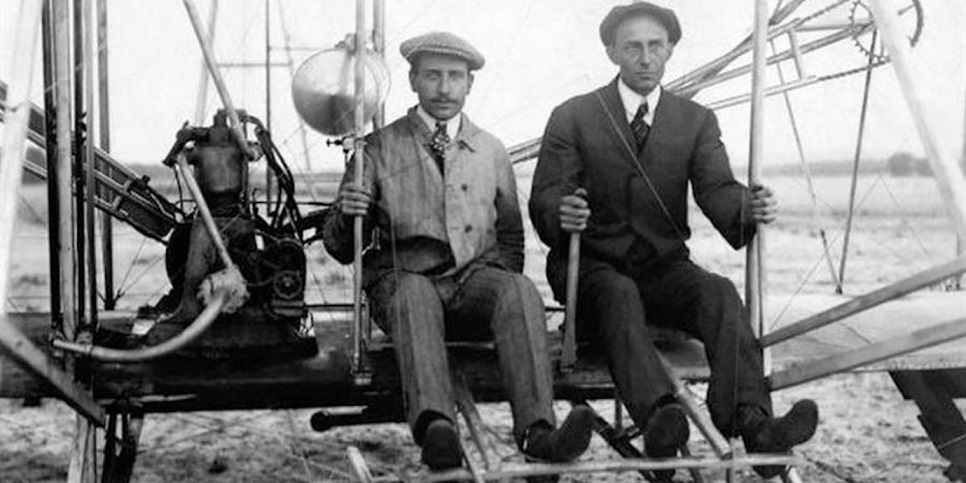
When Orville Wright died Jan. 30, 1948, Charles E. Taylor became the only surviving member of the three who built the first airplane. He was the only employee and intimate associate of Wilbur and Orville Wright throughout the critical years. Taylor built the engines for the Wright’s first planes, specifically to their designs.
Taylor was a machinist, and when the Wright brothers asked if he would like to go to work for them, he decided to take them up on the offer. He reported on June 15th, 1901, for the first time. When the Wright brothers went away to fly, Taylor was alone and in charge of their bicycle company, entrusted with the customers and their money. When the brothers returned later that year, they decided to build a small wind tunnel for testing some of their theories on wings and control surfaces. The three men made a rectangular-shaped box with a fan at one end, powered by the stationary gas engine they had built to drive the lathe, drill press, and band saw. Taylor repurposed some old hacksaw blades for the Wright brothers to use in making balances for the tunnel.
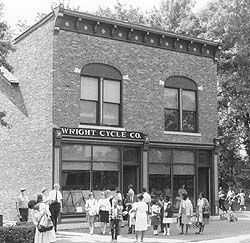
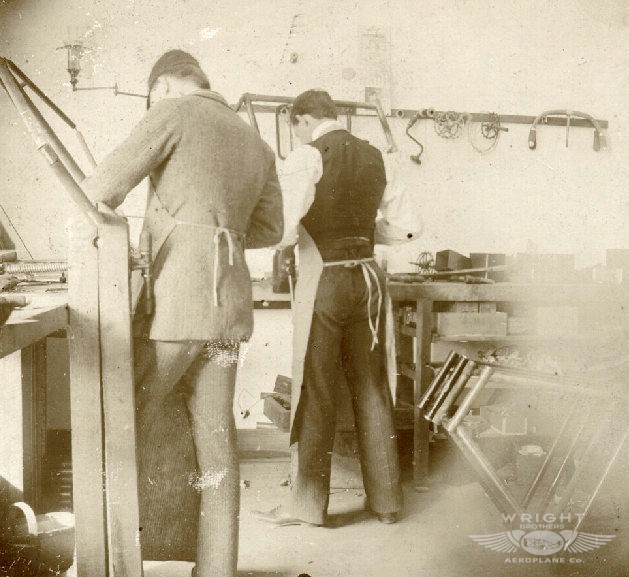
For a long while, Taylor was kept busy with repairing bicycles and waiting on customers. The Wright brothers did most of their experimenting upstairs where they had a small office and workroom, while Taylor worked in the shop in the back room on the first floor. Part of his job was to open up at 7 a.m. and the Wright brothers would arrive between 8 and 9 a.m. They all stayed until closing time at 6 p.m. and went home for lunch at different times so that they did not have to close the shop.
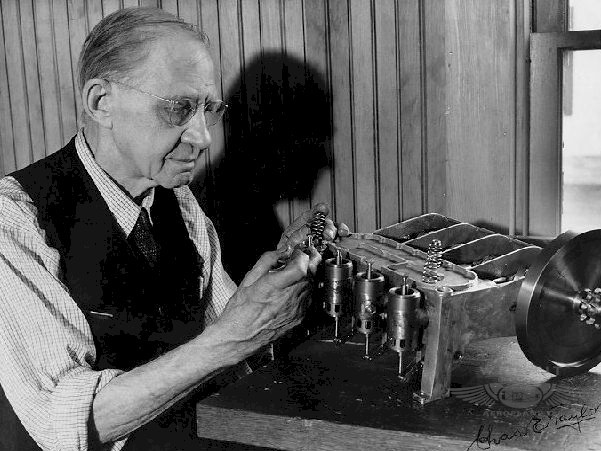
As far as Charles Taylor could figure out, the brothers hired him to worry about their bicycle business, so that they could spend more time concentrating on their flying studies and experiments. However, in 1902, the brothers told Taylor that they were done with gliders and were going to try a powered machine. They knew that they would need a larger machine to carry the motor, so they started to work on a new biplane immediately. During this time, they were trying to locate a motor but nothing was available, so they built one of their own. They planned to use an engine with four cylinders and estimated the bore and stroke at 4 inches. While the brothers were handy with tools, they had not done much machine work and were busy on the airframe, leaving the engine up to Taylor - whose only experience with a gasoline engine was attempting to repair one in an automobile, back in 1901.
One of the three men would sketch out whatever they were talking about on a piece of paper, and Taylor would tack the sketch over his bench. It took him six weeks to make the engine. The only metal-working machines they had were a lathe and a drill press, which were run by belts from the stationary gas engine.
The crankshaft was made out of a block of machined steel. Taylor traced the outline on the slab, then drilled through with the drill press until he could knock out the surplus pieces with a hammer and chisel. He then put it on the lathe and trimmed it down to size. The body of the first engine was made of cast aluminum. The pistons were cast iron, and these were turned down and grooved for piston rings. The completed engine weighed 180 pounds and developed 12 horsepower at 1,025 revolutions per minute.
While Taylor was doing all this work on the engine, the Wright brothers were upstairs working on the airframe. They asked Taylor to make the metal parts, such as the small fittings where the wooden struts joined the spars, and where the truss wires were attached. There weren’t any turnbuckles in the truss wire, so the fit had to be just right. It was so tight, they had to force the struts into position.
The fuel system was simple. A single-gallon fuel tank was suspended from a wing strut, and the gasoline was fed by gravity from a tube to the engine. The fuel valve was an ordinary gaslight pet cock. There was no carburetor. The fuel was fed into a shallow chamber in the manifold. Raw gas blended with air in this chamber, which was next to the cylinders and heated up rather quickly, which helped vaporize the mixture. The engine was started by priming each cylinder with a few drops of raw gas. The ignition was the make-and-break type. There were no spark plugs, so sparks were made by the opening and closing of two contact points inside the combustion chamber. These were operated by shafts and cams which were geared to the main camshaft. The ignition switch was an ordinary single-throw knife switch that Taylor and the Wright brothers bought at the hardware store. Dry batteries were used for starting the engine, and then the men switched onto a magneto bought from the Dayton Electric Company. There was no battery on the plane. Several lengths of speaking tube were used in the radiator. The chains to drive the propeller shafts were specially made by the Indianapolis Chain Company, but the sprockets came ready-made. Roebling wire was used for the trusses.
Charles Taylor said that the most challenging job the Wright brothers had was with the propellers. Taylor didn’t believe they were ever given enough credit for that development. The brothers had read up on all that was published about boat propellers, but they couldn’t find any formula for their purposes. So they had to develop their own, according to Taylor. They concluded that an air propeller was really just a rotating wing, and by experimenting in the wing box, they arrived at the design they wanted.
They made the propellers out of three lengths of wood, glued together at staggered intervals. Then they cut them down to the right size and shape with a hatchet and a drawshave. There wasn’t enough space in the shop at Dayton for the three men to assemble the whole machine there.
During all of this, they still had bicycle customers. The Wright brothers had to keep the business going in order to pay for the flying experiments. There wasn’t any other money to support them. While the boys always worked hard and there was never any horseplay around the shop, Taylor said that they always seemed to find time to stop and talk with customers or humor the neighborhood children who wandered in. "Sometimes I think the kids were the only ones who really believed that Will and Orv would fly. They hadn’t learned enough to say that it couldn’t be done," said Taylor.
Charles Taylor and the Wright brothers block-tested the motor before crating it for shipment to Kitty Hawk. They rigged up a resistance fan with blades an inch and a half wide, and 5 feet 2 inches long. The brothers figured out the horsepower by counting the revolutions per minute.
Charles Taylor was running the bicycle shop alone for the third time when the Wright brothers officially flew the machine. They sent a telegram to their father saying they had made four successful powered flights on December 17, 1903, and they would be home for Christmas.
Taylor explained that the Wrights didn’t go into the airplane experiment with the idea of making a lot of money. They just seemed to be curious about the problems involved and were determined to find out how to make it work. Charles Taylor was happy working for the Wright brothers, and knew they were pleased with his abilities.
Orville Wright gave Charles his first flight in 1908. He offered Taylor a hop at Fort Myer, VA, when they were demonstrating the Wright airplane for the first Army contract. Taylor was in the passenger’s seat preparing for takeoff when a high-ranking officer asked Orville if he wouldn’t mind taking along an Army observer instead. Naturally, Taylor got out, and Lt. Selfridge took his place. The machine crashed shortly after takeoff. Lt. Selfridge was killed, and Orville was seriously injured. Lt. Selfridge was the first military air casualty. Since then, a lot of people have said that they narrowly avoided being killed in airplanes by a last-minute switches in plans. Taylor said maybe he was the first.
In May 1910, Orville finally took Taylor up at Simms Station, and he did a lot of what pilots had done in later years with their first-flight passengers. He tried to give Charles Taylor a scare. They were flying over a field when suddenly the plane began to pitch violently. Taylor grabbed hold of a strut and looked over at Orville who didn’t seem upset, but appeared to be having a hard time controlling the machine. When the pitching stopped and the two men landed, Orville asked Charles if he was afraid; to which he responded, "No, if you weren’t, why should I be?"
Taylor always wanted to learn to fly, but he never did. The Wright brothers refused to teach him and tried to discourage the idea. They told Taylor that they needed him in the shop to service their machines, and if he learned to fly, he would be gadding about the country and may become an exhibition pilot and they would never see him again.
One of Taylor’s jobs during the summer of 1904 was a pseudo airport manager. He was busy that summer testing the new airplane which was built to replace the Kitty Hawk machine. The men barely had time to keep the bicycle business running, so the following summer, they gave it up. Taylor built nearly half-a-dozen engines for the brothers before the airplane company was formed in 1909 and they took on additional help. The brothers also had Charles doing repair work on the airframe, and as they began to travel around to demonstrate machines, it was up to Taylor to help with all of the crating, uncrating, and assembling.
After starting the company in 1909, more men were hired, and Taylor was put in charge of the engine shop with men working under him. The business was growing and it was no longer just the three of them. A close friend of the brothers, Robert J. Collier (who owned stock in the company) bought the first plane for private use. Then, Calbraith Perry Rogers came down to Dayton in 1911 to see about the machine he had ordered for his proposed transcontinental flight and offered Taylor $10 a day (plus expenses) to be his mechanic on the trip.
At that time, Taylor’s wages were $25 a week. When Taylor told the brothers about his proposition, the Wright brothers begged him not to quit and asked that he just take a leave of absence and come back to them afterwards. It was Taylor’s job to care for the plane every night and make repairs after every mishap. Rogers failed to win the $50,000 prize posted by Williams Randolph Hearst because he took longer than 30 days to make the national crossing. Even so, it was the first coast-to-coast flight.
Charles Taylor’s wife became ill in California, so he didn’t make it back to the East until the Fall of 1912. When he returned, things were not the same. Wilbur Wright had died from typhoid fever on May 30, and there were many new faces around the Wright plant.
After Orville Wright sold the company and retired to his laboratory in 1915, Taylor stayed with him to help out with some of his inventions and kept his car in good running order. The work gradually decreased and Taylor took a job downtown with the Dayton-Wright Company in 1919.
Before this, in 1916, Charles and Orville took the Flyer out of storage and fixed it up for the first exhibition at the Massachusetts Institute of Technology in Cambridge. Taylor said that if it hadn’t been for Roy Knabenshue, the original Wright Flyer may not have been preserved. Roy had approached Wilbur Wright in early 1912 and asked him what he was going to do with the Flyer, and Wilbur told him, "Oh, I guess we’ll burn it. It’s worthless." Roy argued that it was historic and finally talked him out of destroying the plane. After that, it was forgotten about until Orville received a request to show it in Massachusetts.
Lester D. Gardner (then publisher of Aviation magazine, later an officer in the Army Air Service in World War I and founder of the Institute of the Aeronautical Sciences) initially requested the plane be used in an exhibit. Orville was reluctant at first, but consented when Gardner and Roy convinced him of the Flyer’s value to the public.
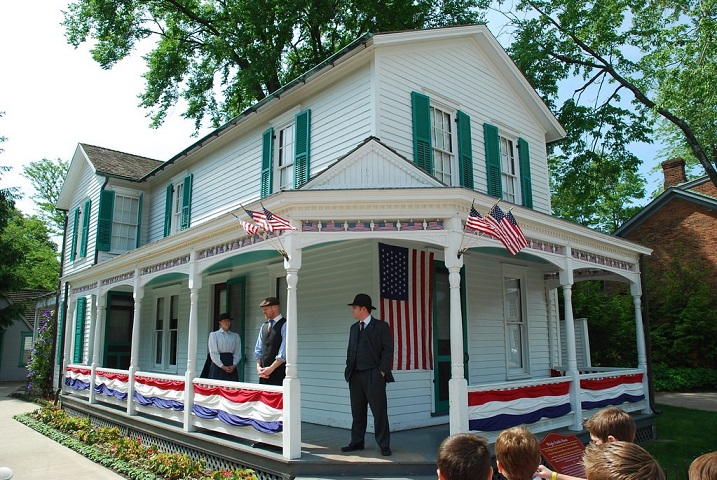
In 1937, Henry Ford hired Taylor to help restore the original Wright home and shop when he moved them to his Greenfield Village museum at Dearborn, MI. The buildings were installed near the first Ford workshop and Thomas Edison’s original laboratory. Taylor helped Fred Black (the director of the project) track down the original machinery and furniture, and then built a replica of the first Wright engine. The home and shop were dedicated in April of 1938 with all the big names in aviation on hand.
Charles returned to California in 1941, but he kept in contact with Orville. They wrote regularly about their work, and Orville wrote every December 17th. Taylor says it was sort of a personal anniversary for them, and also served as a Christmas greeting. Orville hinted at Charles coming back into the laboratory with him, and while he wanted to, Orville never came right out and asked him. Taylor intended to go back East that summer if he was able, but Orville died on January 30th. In the last note that Charles received from Orville, shortly before he died, he wrote: "I hope you are well and enjoying life, but that’s hard to imagine when you haven’t much work to do." It was signed, "Orv."
Charles E. Taylor died January 30, 1956, at the age of 88.