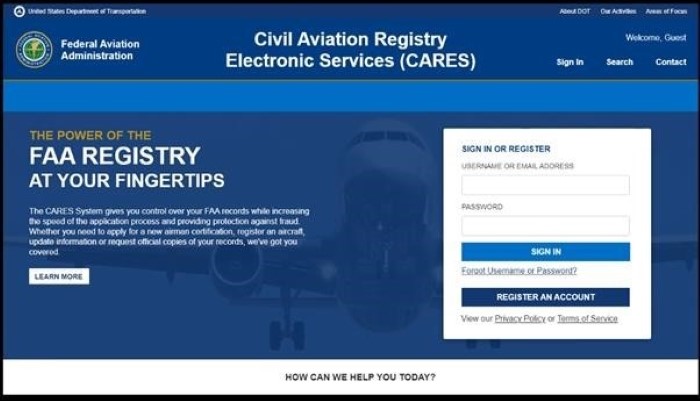
The Civil Aviation Registry Electronic Services (CARES) initiative is responsive to Section 546 of the Federal Aviation Administration (FAA) Reauthorization Act of 2018 (Pub. L. 115-254), which directs the agency to make a number of upgrades to the Civil Aviation Registry. There are also several GAO and OIG articles that CARES will help address such as GAO-20-164, "FAA Needs to Better Prevent, Detect, and Respond to Fraud and Abuse Risks in Aircraft Registration." CARES will be a new web-based service for registration of all U.S. aircraft, and certification of all U.S. airmen, including unmanned aircraft systems (UAS). It will replace current Civil Aviation Registry processes and legacy systems to support organizational operations with a modernized enterprise solution to meet requirements.
The Civil Aviation Registry (Registry) resides within the FAA Aviation Safety (AVS) organization, which is responsible for setting, overseeing and enforcing safety standards for any person or product operating within the National Airspace System (NAS). AVS is also responsible for developing, maintaining, and operating national programs for the registration of United States civil aircraft. This includes responsibility for recording conveyances, (leases, security instruments, liens) that affect aircraft, engines, propellers, and appliances; and issuing airmen certificates. Under AVS’ direction, the Registry provides services in accordance with Title 49 U.S.C. Chapter 441 (Registration and Recordation of Aircraft) and Title 49 U.S.C. 44703 (Airman Certificates).
Since 2016, the Registry has been examining ways to modernize its aircraft registration and airmen certification services. The Registry employed a consultant to evaluate existing processes and systems to identify areas of improvement, and a final report for the study was delivered in January of 2017. Based on the results of the analysis, the Registry subsequently conducted an examination of potential modernization options. The results of this effort (also conducted by a consultant) were documented in a final report that was delivered in September of 2017. As a result, the Registry began planning modernization efforts through a traditional approach - an effort that was expected to take several years to accomplish. After receiving Congressional direction in October of 2018, the FAA began exploring approaches to accelerate the modernization timeline. The FAA conducted three Requests for Information (RFI) which helped inform and refine the FAA’s operational, financial, and technical strategies leading to the procurement approach. The CARES task order was effective August 28, 2020.
The Registry has worked closely with many FAA partners to get CARES design and development started. The Operations Governance Board (OGB) provided insight and oversight to help confirm that the Registry was ready for implementation, and had a sound procurement approach. The development team was interviewed, hired, and (thanks to FAA Security) has gone through suitability screening rather quickly. We are also partnering with the Office of Communications (AOC) to coordinate communications with our many public stakeholder organizations. Many organizations have reached out, asking how they can help, and the Registry appreciates the interest and support of this effort.
As a result, the CARES development team, which is operating in a fully-virtual mode, has been able to hit the ground running, navigating the logistical aspects of getting new government-furnished equipment delivered, and the necessary software installed. The team’s members are widely dispersed across the country, and in fact, few of them have actually met in person.
Yet, through an ongoing partnership with FAA’s Information and Technology Services (AIT), - who established the technology foundation for a secure, cloud-based technology development project - the team has been able to design an approach that leverages the most advanced technology available. The methodology fueling system development involves iterating through a process of capturing rules, regulations and requirements. This information is vetted by subject matter experts through frequent demonstrations that capture feedback, which is siphoned into further system development.
Like the development approach for CARES, implementation planning and scheduling is following a continuous improvement, phased roll-out. The initial focus is to deliver baseline registry functionality through a web-based environment. The CARES modular roll-out approach will first address aircraft registration functionality, and subsequently, airmen certification services and drone registration services. This priority sequence was based on factors such as existing online capabilities, rulemaking requirements and Congressional requirements. Advanced capabilities and system enhancements will be continually scoped out and incorporated where appropriate, throughout the CARES lifecycle.
The Registry is happy to reside at the MMAC and we look forward to sharing our journey with you. For more frequent updates please visit faa.gov/go/CARES, and we will also share more through MONRONeYnews!