Story by Shannon Farley (AMA-400)
All photos courtesy of AMA-400
In early 2020, the global health crisis threat began changing social and professional interactions. The FAA resorted to maximum telework quickly, and entered emergency action discussions. During the week of March 9, 2020, the FAA Academy’s Technical Operations Training Division (AMA-400) had approximately 400 students on campus at the Mike Monroney Aeronautical Center (MMAC). The FAA Academy started working with the FAA Air Traffic Organization (ATO), Technical Operations (AJW), and Safety and Technical Training (AJI) directorates to assess the current on-site classes for critical need criteria, early completion, and even cancelation.
On Monday, the week of March 16, 2020, AMA-400 had 290 technical operations students on campus. The AMA-400 instructors were exploring all options to complete classes early for the students that were currently away from home. Further collaborative discussions between the FAA Academy, AJW, and AJI were held to establish mitigation plans for the classes in session. Any training scheduled to start that week was canceled. The FAA Academy analyzed all the in-session courses and provided the critical training that could be completed within the week. By that Monday evening, all non-critical classes were canceled and those students returned to their home facilities with their course completion pending. By the end of the week, no students were at the FAA Academy and all employees for AMA-400 were moved to full telework until further notice. The AMA-400 classes held in person at the FAA Academy would not begin again until August 2020.
The FAA Academy collaborated with AJW and AJI to complete the Instrument Landing System (ILS) Concepts and Navigation (NAV) Concepts courses, as well as the Standard Terminal Automation Replacement System (STARS) Software and Security course, which were all interrupted due to the global health crisis. The FAA Academy finished these classes using Zoom as a delivery platform for the remaining lecture materials that were required by the students, and the Academy’s eTesting software supported the remote delivery of the final examinations.
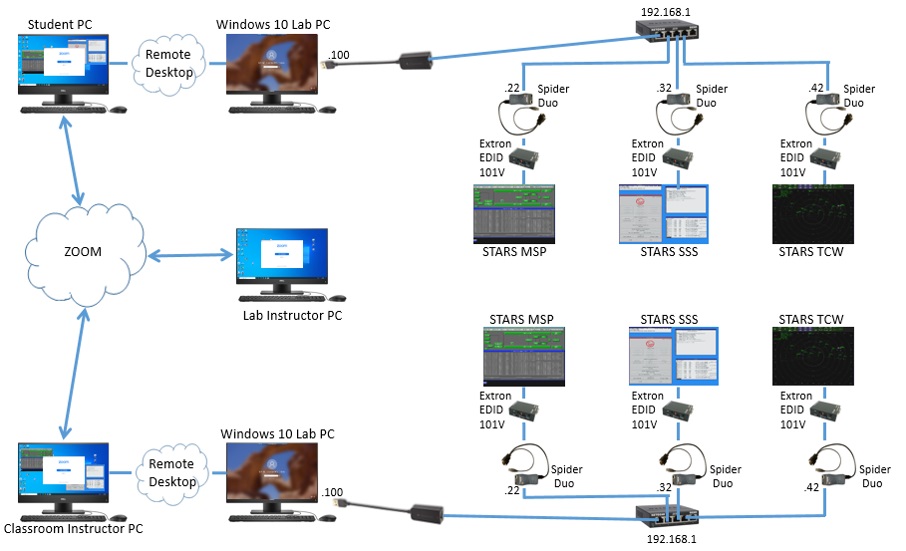
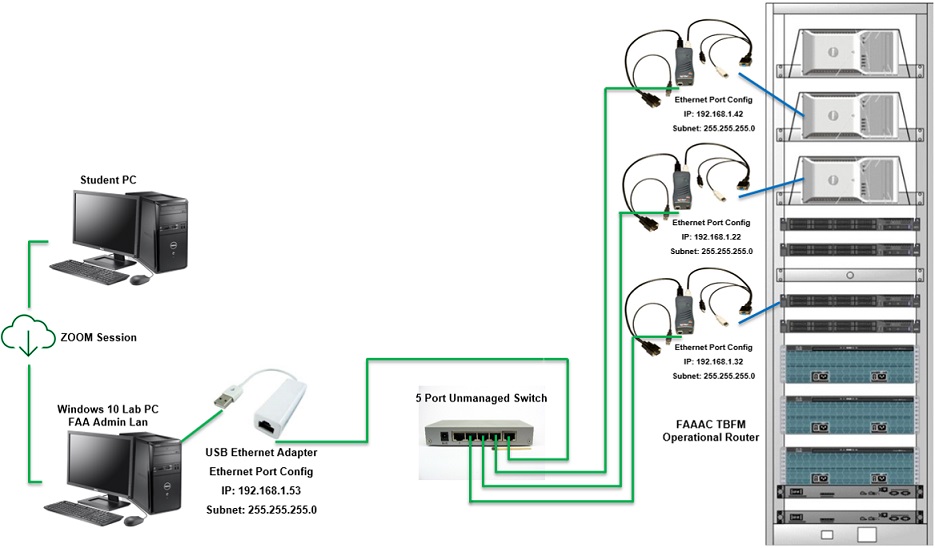
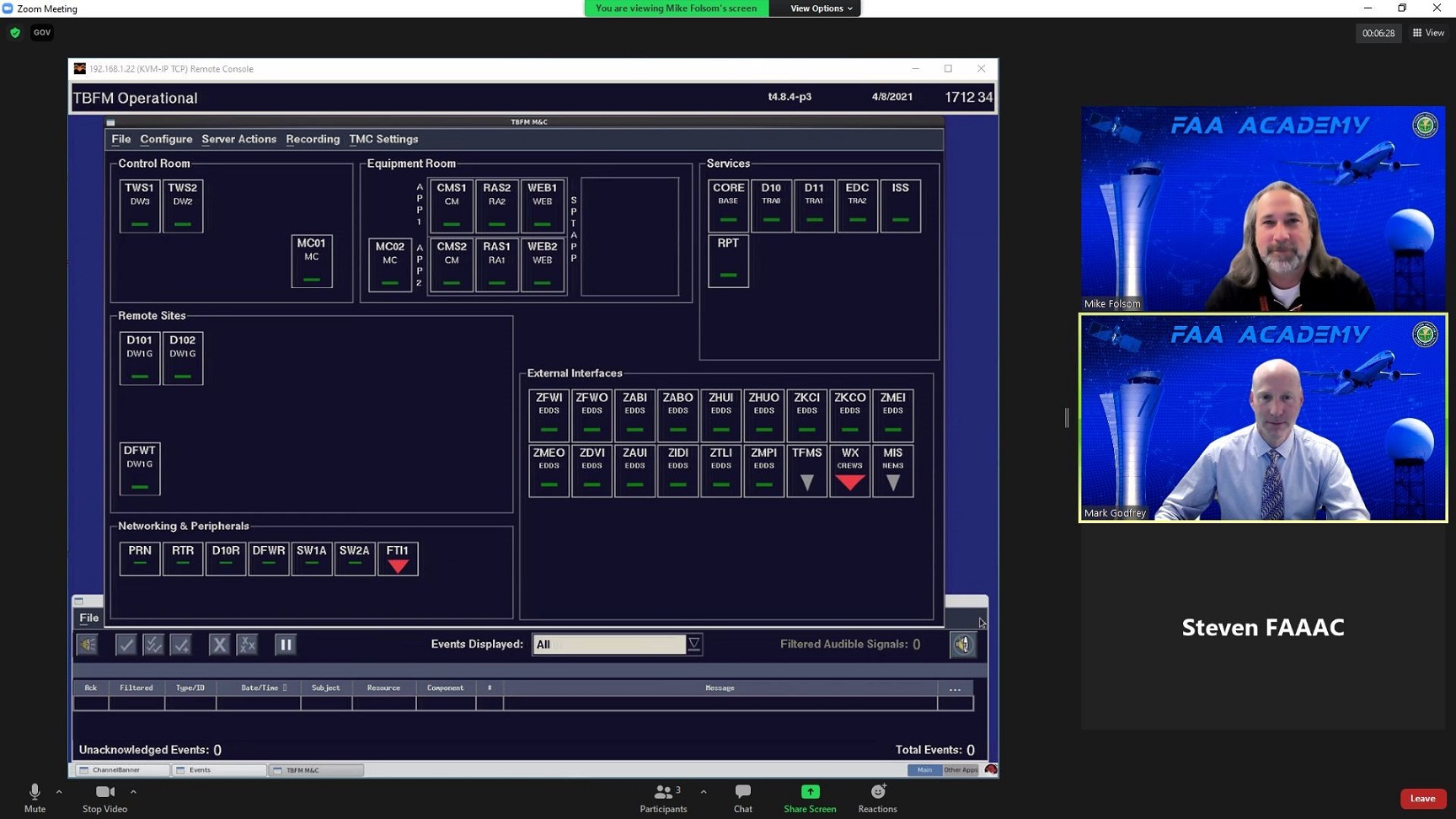
Once the FAA Academy received approval to convert more classes to virtual platforms, the AMA-400 team researched technological options and purchased special cameras and equipment, enabling the delivery of high-quality training remotely, and under parameters set for the new environment. The FAA Academy also purchased video recording equipment for lab demonstrations in classes like the ILS Concepts Course, where students would normally go out in the field to perform antenna measurements. For other classes like Time Based Flow Management (TBFM) and STARS, where a majority of student labs needed to be completed on the FAA Academy lab system computer, the AMA-400 team employed the use of the Lantronix SpiderDuo, which is a tool designed for remote access and troubleshooting using keyboard, video, and mouse (KVM) control over a local internet protocol (IP) network.
The SpiderDuo technology not only allows the instructors to access the lab system keyboard and mouse, it also provides student access to the isolated lab system for completing lab exercises remotely via the remote desktop application. The original plan for TBFM virtual training included a resident lab portion, but with this innovation, the TBFM course is now completely virtual, as are two of the STARS courses!
The variation of equipment in the National Airspace System (NAS) also created challenges for AMA-400. While some NAS equipment used to monitor, control, and interface with personal computers (PCs) are the latest and greatest, the NAS also includes Legacy PCs still running on Windows 3.11. Initially, showing the Legacy equipment computer screens over Zoom was indistinguishable due to the aspect ratios. For these situations, AMA-400 implemented video converters to change the Legacy aspect ratios over to a clear resolution for visuals and interactive training; one example of this was with the use of a video grabber made by Epiphan (DVI2USB 3.0), designed to convert any video in its original format to a USB output that is accepted by any Windows 10 PC with a USB port, which could then be shared over ZOOM.
The AMA-400 team has also been assisting AJI with the development activities for courses like the Micro En Route Automated Radar Tracking System (MEARTS) Hardware course. The AMA-400 team set up technology to enable the Operational Tryout activity of this course to occur remotely, utilizing Zoom communications for the lectures and added equipment in the labs for remote collaboration on lab procedures. As a result, the observers for the Operational Tryout activity were located in Puerto Rico, Hawaii, Guam, Oklahoma City and Washington, DC. As of April 2021, AMA-400 has converted 28 courses to purely virtual or a blended learning platform.