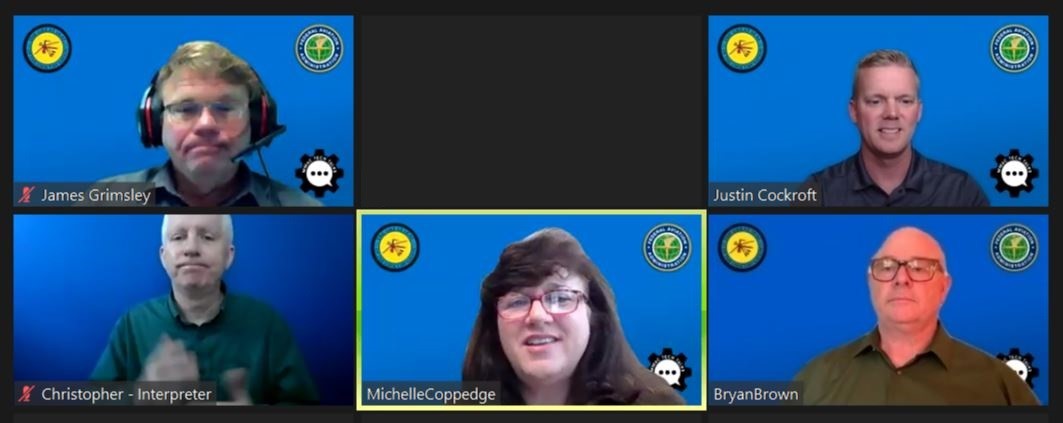
Curious minds came together on June 22, 2020, to explore the emerging frontiers of Unmanned Aerial Vehicles and Electric Propulsion, and integrating these new modes of transportation into the National Airspace System (NAS). These topics were central at the inaugural Mike Monroney Aeronautical Center (MMAC) Tech Talk. Almost 125 people joined the MMAC Tech Talk from all across the nation via Zoom Webinar to hear from experts discussing these topics.
Michelle Coppedge, (Mike Monroney Aeronautical Center Director) kicked-off the webinar by welcoming everyone attending and introducing the MMAC Tech Talks, stating, "Each quarter, we plan to showcase an industry expert on the topic of aviation, aerospace and business. The Tech Talks will offer a glimpse of where technology stands today, highlighting current trends and exploring how these trends impact the way we live. We’ll also look at problem solving strategies using innovation and collaboration while utilizing cost effective measures." Director Coppedge invited the audience to enjoy and learn from the presentation. She continued, "We hope this presentation sparks your curiosity and influences you in wanting to learn more about any aspect of aviation."
Keynote speaker for the MMAC Tech Talk, The Honorable James Grimsley, Executive Director of Advanced Technology Initiatives for the Choctaw Nation of Oklahoma, is a nationally recognized expert on policy and technology related to unmanned aircraft (drones) and autonomous systems. James holds a Bachelor of Science degree in Aerospace Engineering and a Master’s of Science in Mechanical Engineering. Through his direct involvement, The Choctaw Nation was selected as one of ten sites to participate in the FAA’s Unmanned Aircraft Systems Integration Pilot Program by U.S. Secretary of Transportation Elaine Chao. Mr. Grimsley also currently serves as the Oklahoma Transportation Commissioner and is the Founding President of the Unmanned Systems Alliance of Oklahoma (USA-OK).
In his talk titled, "Catalysts and Barriers for Widespread Adoption of Distributed Electric Propulsion," Grimsley pointed out that there have been two revolutions in aviation technology. The first was the inception of flight itself as the Wright Brothers pioneered motor-operated flight. The second revolution was the development of jet-engine technology. Mr. Grimsley pointed out that many people view Unmanned Aircraft Systems (UAS) as the third revolution. However, UAS technology has existed for over 100 years. "There’s been all sorts of autonomy in aviation for a long time so that’s really not the third revolution as some of us have started to realize."
Mr. Grimsley proposed that we are currently experiencing the advent of a third revolution in aviation technology; electric propulsion. "Many people argue that the third revolution is electric propulsion because it’s changing how we design aircraft. We can design anything that weighs a few ounces all the way up to something that carries passengers. We have that full spectrum now because of electric propulsion. Eelectric propulsion also begins to change our design philosophy. We have fewer moving parts which means we hopefully have better reliability. It becomes easier to make things fly and we’re starting to see an acceleration in design concepts, especially with the urban air taxis and the technologies that are emerging now. We’re starting to see these things developed very quickly compared to our conventional aviation aircraft development cycles."
Acknowledging that there are barriers to widespread adoption of electric Vertical Take-Off Landing (eVTOL) Unmanned Aerial Systems, Grimsley discussed the integration of these emerging technologies. "We’re trying to integrate aircraft into a very complex, but safe aerospace system. We are in the golden era of aviation system safety. We’ve almost eliminated air carrier accidents. We are at a period that I would not have imagined 30 years ago. I thought 30 years ago that we were possibly going to become less safe," Mr. Grimsley said. Concerning eVTOL, he noted that "Public perception is key. It’s how people see it. Sometimes these perceptions (right or wrong), can get hardwired into society and people either decide that they don’t like it or they do like it. Technology does not always win." It is imperative that people understand the benefits and opportunities that eVTOL presents. Mr. Grimsley concluded that, even though there are challenges, he still has a "very, very optimistic view of aviation for the future."
MMAC Tech Talk attendees also heard from Bryan Brown, manager of the FAA Flight Standards Systems Tools and Information Branch. Brown leads numerous technology innovation and modernization initiatives, and serves as the FAA’s Data Co-Lead, working with National Aeronautics and Space Administration (NASA) on the Advanced Air Mobility National Campaign. He and his team’s primary mission is to provide research into technologies and systems that support risk-based standards, certifications, and oversight of new technologies and systems in the National Air Space (NAS).
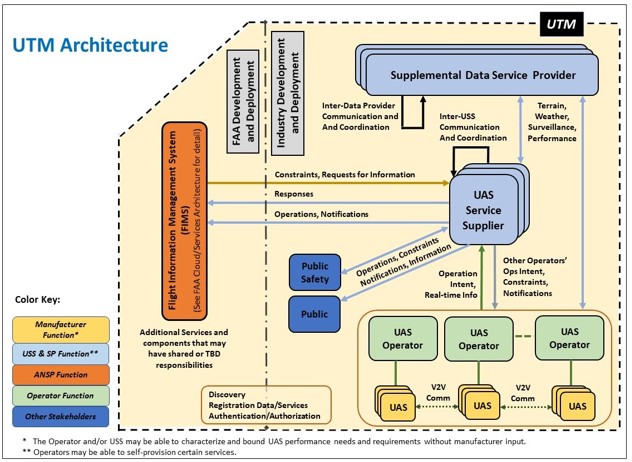
Brown spoke to the "Safe Integration of New Entrants into the NAS" He pointed out that there are dozens of factors that complicate the introduction of new aviation technologies. Different airframes ranging from private and commercial aircraft, supersonic/hypersonic systems, and especially Unmanned Aerial Systems (UAS), must all be coordinated with considerations such as: NAS infrastructure capabilities, environmental factors, budgets, and even emerging technologies like artificial intelligence. To that end, Brown and his team were instrumental in developing the FAA Unmanned Aircraft System Traffic Management Concept of Operations Version 2.0 (FAA UTM ConOps V2.0). This traffic management architecture defines UAS operations below 400 ft. above ground level (AGL) and FAA support for UAS low altitude airspace operations. FAA UTM ConOps V2.0 seeks to get ahead of the integration curve that is presented by the introduction of new technologies by establishing (today) the rules under which everyone will play tomorrow.
The first-ever Mike Monroney Aeronautical Center Tech Talk concluded with Aeronautical Center Director Michelle Coppedge thanking speakers, James Grimsley and Bryan Brown, as well as the Quality Systems and Business Resources Staff (AMC-3) team which was responsible for putting the event together. The plan is for MMAC Tech Talks to be a quarterly presentation hosted by AMC to highlight the integration of aviation and technology. Please be sure to stay tuned and check on Eventbrite for information about next quarter’s offering!