As the aerospace industry continues to grow more complex, the FAA must attract and develop the best and brightest talent, people possessing appropriate leadership and skills. To do this, it requires assessing the workforce’s current skills and strengths to better determine what is needed in an ever-changing industry. Using data from assessment sessions, we can begin to look at what is required to develop a safe and competitive workforce with enhanced knowledge and skills, while simultaneously being able to make safety-informed, risk-based decisions.
In February 2014, Administrator Michael Huerta shared his vision for the agency and announced four strategic initiatives, one of which highlighted risk-based decision making. In his remarks, he stated that the FAA will “build on safety management principles to proactively address emerging safety risk by using consistent, data-informed approaches to make smarter, system-level, risk-based decisions.” As part of this initiative, the Risk-Based Decision Making and the Workforce of the Future Teams have been formed and are developing functional requirements and competencies to ensure that our workforce has the necessary safety data and risk analysis capabilities.
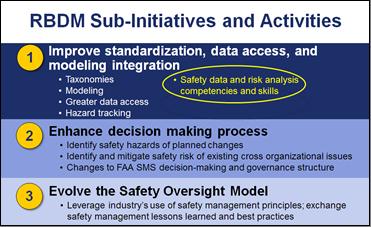
Risk-Based Decision Making (RBDM) is made up of three sub-initiatives and additional activities within each.
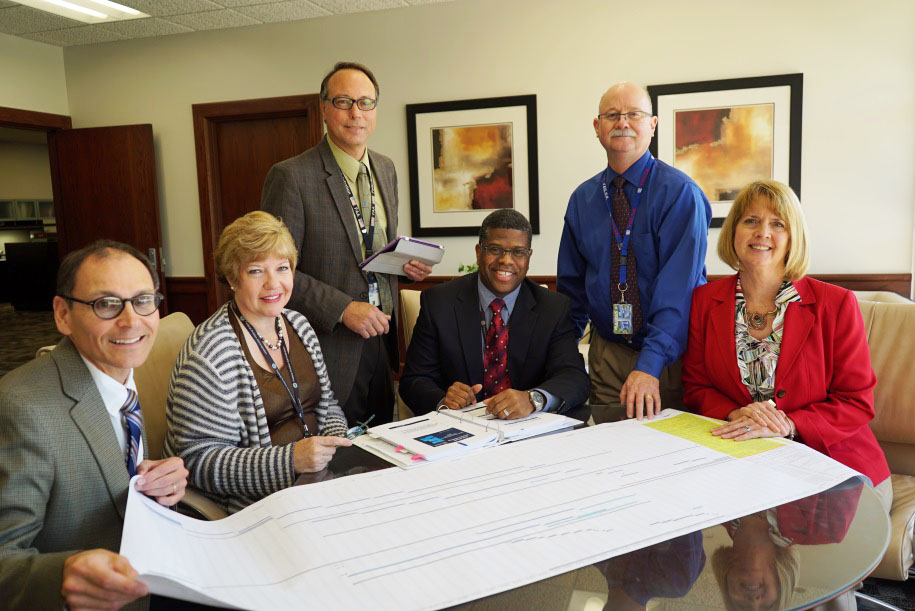
Within the scope of these activities, a team of FAA Academy employees has been tasked with “Safety data and risk analysis competencies and skills” since the beginning of FY-14. Keith Deberry (AMA-200), Chris Dumesnil (AMA-900), Joseph Smith (AQS-500), Charles Carroll (AMA-800), “C” Haley-Seikel (AJI-2150), Lori Maselli (AWM-100), Wayne Coley (AJI-21), Dr. Larry Bailey (AAM-500), Dr. Jennifer Myers (AAM-520), Dr. Dana Broach (AAM-500) and Cynthia Garcia (AMA-200) have participated in the activities as well as involvement from Henry Mogilka (AMA-2) and Sherry Reese (AMA-1). Peggy Gilligan (AVS-1) is the lead for the RBDM Initiative and Sunny Lee-Fanning (AQS-1) is the lead for the (Sub-Initiative 1e) activity.
Recently, the team reported completion of its first milestone to the FAA Safety Management System (SMS) Committee, the AVS SMS Management Board, and the AVS SMS Coordination Group. The milestone signifies the recommendation of concepts that would optimize the flow and reporting of safety data and analytics. Although the completion of this milestone entailed overcoming a big hurdle, the most important milestone is yet to come. The final milestone involves publishing a Strategic Job Task Analysis (S-JTA). This task will bring the most value to this activity and the information will be used to complete other actions in the RBDM and Workforce of the Future initiative. Information from experts and visionaries will be analyzed and developed into a Strategic Job Task Analysis, allowing the agency to better recruit the right individuals, develop thorough training plans to better educate our current staff, help in succession planning, determine promotion criteria, and much more.
Paula Martinez, Program Manager for the Risk-Based Decision Making Strategic Initiative, explained, “The success of risk-based decision making hinges on the ability of our workforce to be able to analyze data and assess risk. The work that is being done in these areas represents the perfect intersection of the Risk-Based Decision Making and the Workforce of the Future strategic initiatives. Together, we will make sure we know exactly the skills that are needed for success, and determine the best way to ensure that those skills are adequately represented in our workforce.”
To define requirements and competencies, teams will assess job series that currently perform data and risk analysis. They will begin their assessments with the job category of Operations Research Analysts (FV-1515) because of the analysts’ profound impact on the aerospace industry and their critical skills related to aviation safety.
These analysts will be identified and will be asked to participate in a survey. Teams will conduct focus group sessions with those employees who volunteer, discussing their daily work activities and the skills they believe are necessary to remain successful in their positions. In addition, teams will also interview agency leaders about the kinds of skills they expect employees to have based on changes in the industry.
The Director for managing FAA’s Workforce of the Future, Ayisha Dabre stated, “We will need to collaborate across organizational boundaries in ways we typically haven’t in the past to ensure the FAA has the right employees, with the right skills, at the right time to meet our industry’s changing needs.” The initiative will work with stakeholders across the agency to identify mission critical positions, assess the skills of the workforce, and assist with the development of technical and functional training.
The world of aviation continues to change dramatically, increasing the complexity of the industry and introducing new and challenging risks into our aerospace system, it’s good to know that the FAA Academy is giving a voice to future generations of aviation.